
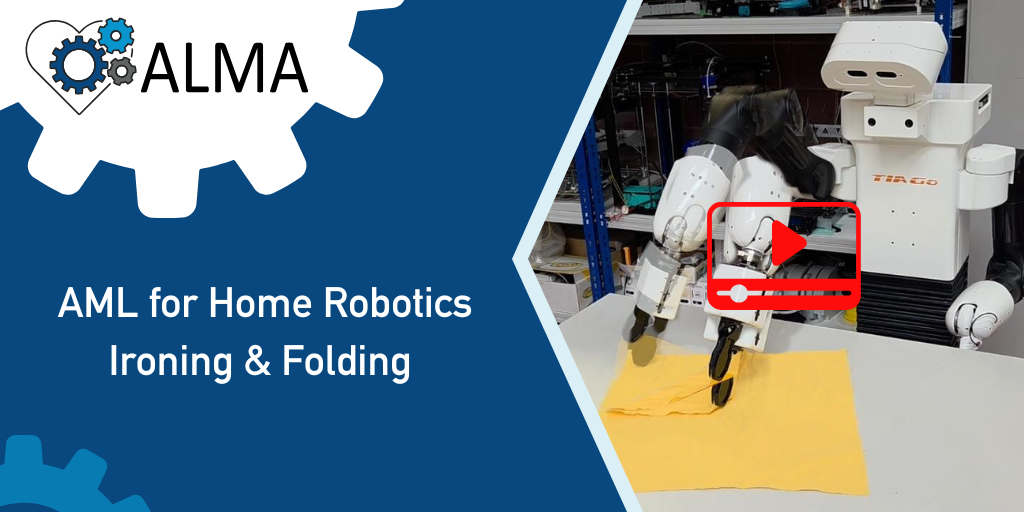
This video presents a summary of the work carried out within Task 7.3, “Higher-level cognition for domestic assistance robots”, led by UC3M in the framework of the European ALMA project. The task culminated with Deliverable D7.6, and this video highlights the key results obtained.
The main achievements shown are:
- Standardized Test Environments: Development of a set of Gymnasium-based Docker containers for benchmarking.
- Practical Application of AML: Implementation of several solvers that apply Algebraic Machine Learning (AML) to ironing and folding tasks, addressing increasing levels of complexity.
- Validation: Extensive testing of the reliability of the algorithms both in simulation environments and on real robotic platforms.
This video provides an overview of the progress made in providing high-level cognitive capabilities to home assistance robots, a key objective within the ALMA project. These tasks from the ALMA project detail investigations into human-centric algebraic machine learning (AML) across various use cases. Task 7.3 is mainly focused on domestic robotics, specifically the development of a benchmark to test AML-based approaches for robotised ironing and garment folding, utilising platforms like the TEO and TIAGo++ robots and simulated environments and its use as a regression model for garment folding based on image input are presented.
WP7 serves as a validation and demonstration pillar, taking the theoretical advancements in algebraic machine learning and applying them to concrete robotic tasks. The specific use cases explored within WP7, as detailed in Deliverable D7.6, are robotized ironing and garment folding. These tasks are part of the laundry pipeline and are chosen to showcase the potential of combining AML with humanoid robotics developed at Universidad Carlos III de Madrid (UC3M).
To achieve the goals of WP7, particularly Task 7.3, several key activities were undertaken:
- Development of Validation Environments: Seven different environments were developed using Gymnasium (formerly OpenAI Gym), a de-facto standard for representing Markov Decision Processes (MDPs), which is the general formalism for Reinforcement Learning problems. These environments include baseline scenarios like Bandit-v0 and GridWorld-v0, as well as environments directly related to the domestic assistance robot tasks: FakeIroning-v0, TeoIroning-v0, TiagoIroning-v0, FakeFolding-v0, and TiagoFolding-v0.
- Focus on Ironing and Folding: The core use cases explored in WP7 are robotized ironing and garment folding/unfolding . For ironing, the task is formulated as an MDP, where the robot learns the best policy to remove wrinkles. Different levels of complexity are introduced, from a 2D "fake" ironing environment to simulations and real-world experiments with the TEO and TIAGo++ humanoid robots. For folding/unfolding, the task is modeled as a supervised learning problem, specifically a regression problem where the robot needs to predict pick and place points. This also involves simulated and real robot experiments with TIAGo++.
- Development of Solver Algorithms: WP7 involved the development and testing of both baseline algorithms and AML-based methods for controlling the robots in the developed environments. For ironing, a baseline Cross-Entropy Method (CEM) and an AML-based "In-context learning" (which can be seen as a path planning method) were implemented. For folding, a Convolutional Neural Network (CNN) served as a baseline for supervised learning, and regression-based AML methods were explored.
- Experimental Evaluation: The developed environments and algorithms were tested in both simulation (using OpenRAVE for TEO and MuJoCo for TIAGo++) and on real humanoid robot platforms, TEO and TIAGo++. This allowed for the evaluation of the algorithms' performance and their potential for real-world application in domestic settings.
- Creation of Datasets and Tools: For the garment folding task, a dataset of labeled images was generated and made publicly available. Additionally, a ground-truth visualizer was developed to aid in the supervised learning approach.
MORE INFORMATION ABOUT ALMA:
For any questions please contact










 This project has received funding from the European Union’s Horizon 2020 research and innovation programme under grant agreement No 952091.