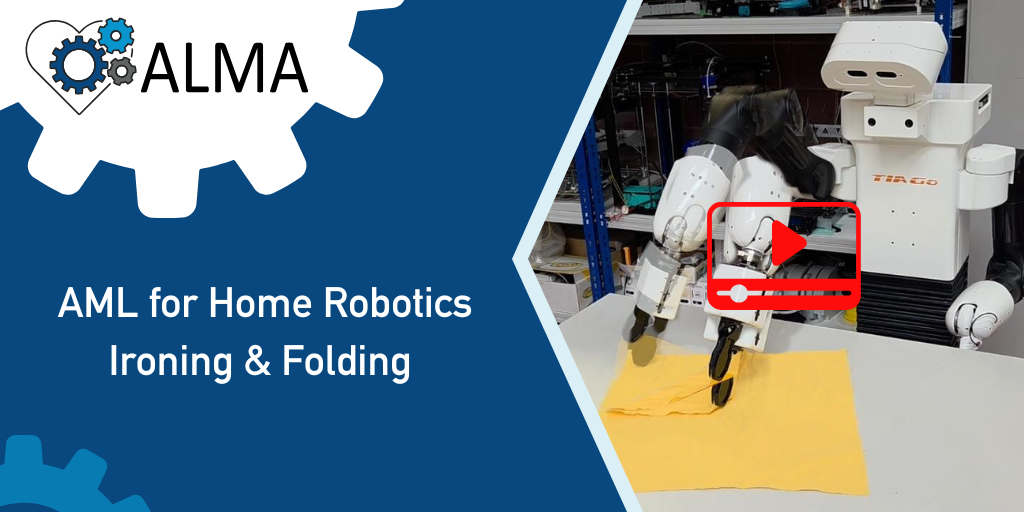
This video presents a summary of the work carried out within Task 7.3, “Higher-level cognition for domestic assistance robots”, led by UC3M in the framework of the European ALMA project. The task culminated with Deliverable D7.6, and this video highlights the key results obtained.

Latest News
As part of the ALMA project’s mission to make Algebraic Machine Learning (AML) accessible and applicable across domains, we present the AML Dashboard—a comprehensive graphical interface designed for training, evaluating, and applying AML models on structured and sensor-based datasets.
Deliverable D5.7 explores how ethical and cultural values can be formally embedded into AML-based world models. It shows how user interactions and situational consequences help autonomous systems learn to behave in socially and culturally acceptable ways. Two short demo videos illustrate these methods in action, offering practical examples of ethical alignment in decision-making.
The ALMA Project has released the Open-AML Engine—an open-source implementation of Algebraic Machine Learning (AML), now available on GitHub. This release marks a key step toward transparent, symbolic AI that aligns with ALMA’s vision for trustworthy and human-centric machine learning. The engine supports reproducible research, modular experimentation, and symbolic reasoning, and comes with complete documentation, including API reference, tutorials, and examples to get started.
The ALMA project is pleased to introduce a new video, Algebraic Foundations of AML, designed to provide an accessible introduction to the principles of Algebraic Machine Learning (AML). This video is tailored for researchers, developers, and industry professionals who seek to understand the fundamental concepts of AML without requiring prior knowledge of abstract algebra.

The ALMA project leverages AML properties to develop a new generation of interactive, human-centered machine learning systems.
Coordinator Office Address
Plaza de la Encina 10-11, Núcleo 4, 2ª Pl.
28760 Tres cantos - Madrid (España)
This project has received funding from the European Union’s Horizon 2020 research and innovation programme under grant agreement No 952091.